- Far more than blowing wind around, wind turbines convert wind into electricity that feeds into the electricity grid, for us to then use in domestic and commercial settings including appliances, transportation, water, and more.
Wind turbines don't blow air around — they convert it into electricity. Here's how wind power works, from a turning blade to the power point in your home.
What Is Wind Energy and How Does It Work?
Wind turbines don't blow air around — they convert it into electricity. Here's how wind power works, from a turning blade to the power point in your home.
Despite common belief, wind turbines are almost the opposite of fans. Far more than moving air around, wind turbines convert the kinetic energy of wind into electricity that feeds into the grid — for use in homes, businesses, transportation, water systems, and more.
What is wind energy?
Wind energy is electricity generated from the kinetic energy of moving air. Despite a common misconception, a wind turbine is almost the opposite of a fan: rather than using electricity to move air, it uses moving air to make electricity, which then feeds into the grid for use in homes, businesses, transport and water systems.
Wind is a renewable resource. It is created continuously by the sun heating the earth's surface unevenly, which means — unlike coal, gas or oil — it cannot be used up, and no fuel needs to be extracted, transported or burned to harness it.
How do wind turbines work?
A wind turbine has three main parts: the blades, the nacelle that houses the generating equipment, and the tower that carries them.
The blades are shaped as aerofoils, like an aircraft wing. As wind passes over them, the pressure difference between the two surfaces creates lift, and the rotor turns. The whole nacelle yaws on its axis so the rotor always faces into the wind for maximum efficiency.
Modern blades are built from lightweight, durable composite materials. They begin turning in winds as low as 11 km/h and are engineered to keep operating in gusts up to 90 km/h, feathering or shutting down above that to protect the machine.
The type of turbine chosen depends on the site — a valley behaves very differently from an exposed ridgeline — but the underlying process is the same everywhere.
How do wind turbines generate electricity?
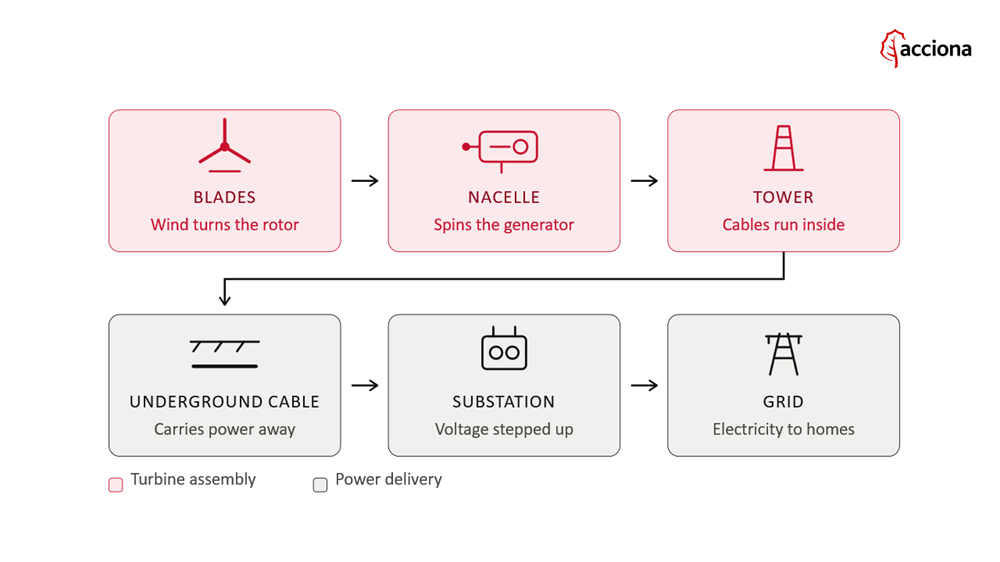
The sequence runs like this:
- Wind turns the rotor. Kinetic energy in the air becomes rotational mechanical energy.
- The drivetrain transfers that rotation to a generator inside the nacelle.
- The generator converts mechanical energy into electrical energy.
- Underground cabling carries the output to a substation within the wind farm.
- The substation steps up the voltage so power can travel long distances with minimal loss.
- The electricity enters the transmission network and is distributed to homes and businesses.
At ACCIONA Energía's MacIntyre Wind Farm in Queensland, that collection network alone runs to more than 1,000 kilometres of underground cable, connecting the turbines to a site substation before an overhead line carries the power to the Tummaville Substation and into the national grid.
How much electricity does one wind turbine produce?
Output is described two ways, and the difference matters.
Rated capacity is the maximum a turbine can produce at any given moment. Each Nordex Delta4000 turbine at MacIntyre is rated at 5.7 MW.
Annual generation is what it actually delivers over a year, which depends on how consistently the wind blows at that site.
Scale changes the picture completely. MacIntyre's 162 turbines have a combined capacity of 923.4 MW, making it one of the largest onshore wind farms in the world and the largest operating wind farm in the southern hemisphere. Together they will produce enough electricity for around 700,000 homes [VERIFY], roughly doubling Queensland's wind generation.
Turbine technology has moved fast. Machines installed 20 or 30 years ago were typically rated below 1 MW and powered a few hundred homes each. Advances in blade design, materials and real-time wind monitoring mean one turbine today produces several times more electricity from the same patch of ground.
Wind energy in Australia
ACCIONA Energía has been developing wind power in Australia since 2002, and operates wind farms across several states.
- MacIntyre Wind Precinct, Queensland — 923.4 MW across 162 turbines on a 32,000-hectare site near Goondiwindi. The precinct is being developed toward around 2 GW of total capacity, alongside the 400 MW / 800 MWh Karara Battery Energy Storage System.
- Mortlake South Wind Farm, Victoria
- Cathedral Rocks Wind Farm, South Australia
One of wind energy's advantages is that it shares land rather than taking it. MacIntyre is built on country used predominantly for sheep farming, and host farmers continue to run their properties around the turbines. Foundations, access tracks and substations occupy only a small share of the site, and lease payments give farming families an income that keeps coming through drought and flood.
How long do wind turbines last, and can they be recycled?
Modern wind turbines are designed for an operational life of around 30 years.
Most of a turbine is already recyclable through established supply chains: the steel tower, the cast iron and copper components in the nacelle, and the concrete foundation.
Blades are the harder problem. They are made from composite materials — fibreglass or carbon fibre bonded with epoxy resin — engineered to survive three decades of structural loading, which is precisely what makes them resist conventional recycling. Progress is rapid: thermoplastic resin systems allow blades to be broken down and materials recovered; mechanical grinding turns blade material into a raw input for cement production; and chemical recycling methods now emerging can recover high-quality fibres for reuse.
ACCIONA applies circular economy principles across the full asset lifecycle, planning for decommissioning and material recovery from the design and procurement stage rather than at end of life.
Monitoring a wind farm
A wind farm of any size needs continuous monitoring to track turbine performance and resolve faults quickly. Surveillance runs from a central control room or remotely via tablet and smartphone, giving real-time analysis of wind speeds, power output and grid voltages, along with the ability to compare sections of a wind farm against each other and against historical data.
Learn more about our operations and maintenance capability →
ACCIONA's wind energy expertise
ACCIONA Energía is the largest 100% clean energy company in the world, and has led Energy Intelligence's Top 100 Green Utilities ranking since 2015.
Our expertise extends to the technology itself: ACCIONA developed its own wind turbine-generator technology before merging that business with the German manufacturer Nordex in 2016, becoming its largest shareholder and retaining a presence across the entire wind energy value chain — development, financing, construction, commissioning and decades of operation.
Explore our energy solutions → · See our Australian projects →
Frequently asked questions
Is wind energy renewable?
Yes. Wind is generated continuously by the sun heating the earth's surface unevenly, so it cannot be depleted, and no fuel is burned to convert it into electricity.
How fast does the wind need to blow for a turbine to work?
Modern turbines start generating in winds as low as 11 km/h and keep operating in gusts up to 90 km/h.
How many homes can one wind turbine power?
It depends on the turbine's rated capacity and the strength of the wind at the site. Across MacIntyre's 162 turbines, the wind farm will supply around 700,000 homes.
Do wind farms stop farmers using their land?
No. At MacIntyre, host farmers continue grazing livestock across the 32,000-hectare site while the turbines operate around them.